

Living on a farm changes the way you look at food.
Before we moved here, a pint of blueberries was mostly a pint of blueberries. Now I see everything behind it. I see the bushes that took years to mature, the frost that showed up at exactly the wrong time, the person picking in July heat, the tractor repair, the fertilizer, the insurance, the buckets, the refrigeration, the payroll, the taxes, and all the other expenses that somehow have to fit inside the price someone is willing to pay.
Once you see food that way, the grocery store starts looking different too.
A steak is not simply a steak. Somewhere there was a rancher, land, feed, fencing, veterinary care, fuel, financing, transportation, slaughter, processing, packaging, distribution, refrigeration, and retail. There are a lot of hands between the animal and the plastic-wrapped package under fluorescent lights.
What interests me lately is how few of those hands increasingly control the middle.
I went down a rabbit hole recently about Cargill. The company began in 1865 with a grain warehouse in Iowa. Today it operates in 70 countries, employs more than 150,000 people, and reported $164 billion in revenue in its 2026 fiscal year. Cargill itself describes its position as being “at the heart of the supply chain,” which is a pretty accurate description. It touches grain, meat, animal feed, oils, ingredients, transportation, trading, and many other parts of the global food business.
Cargill’s history tells a much bigger story about American agriculture. Over generations, companies learned that enormous power could be accumulated by controlling the infrastructure around food. You did not necessarily have to grow the wheat if you owned the grain elevator, transportation network, processing facility, market information, or trading operation the wheat had to pass through. Cargill’s strategy is an “endless belt,” a system designed to participate economically at multiple points as food moved from the farm toward the consumer.
That is smart business.
It also raises a question that I think America has ignored for too long: what happens when the middle gets so powerful that the people at either end have very little leverage left?
Consider beef.
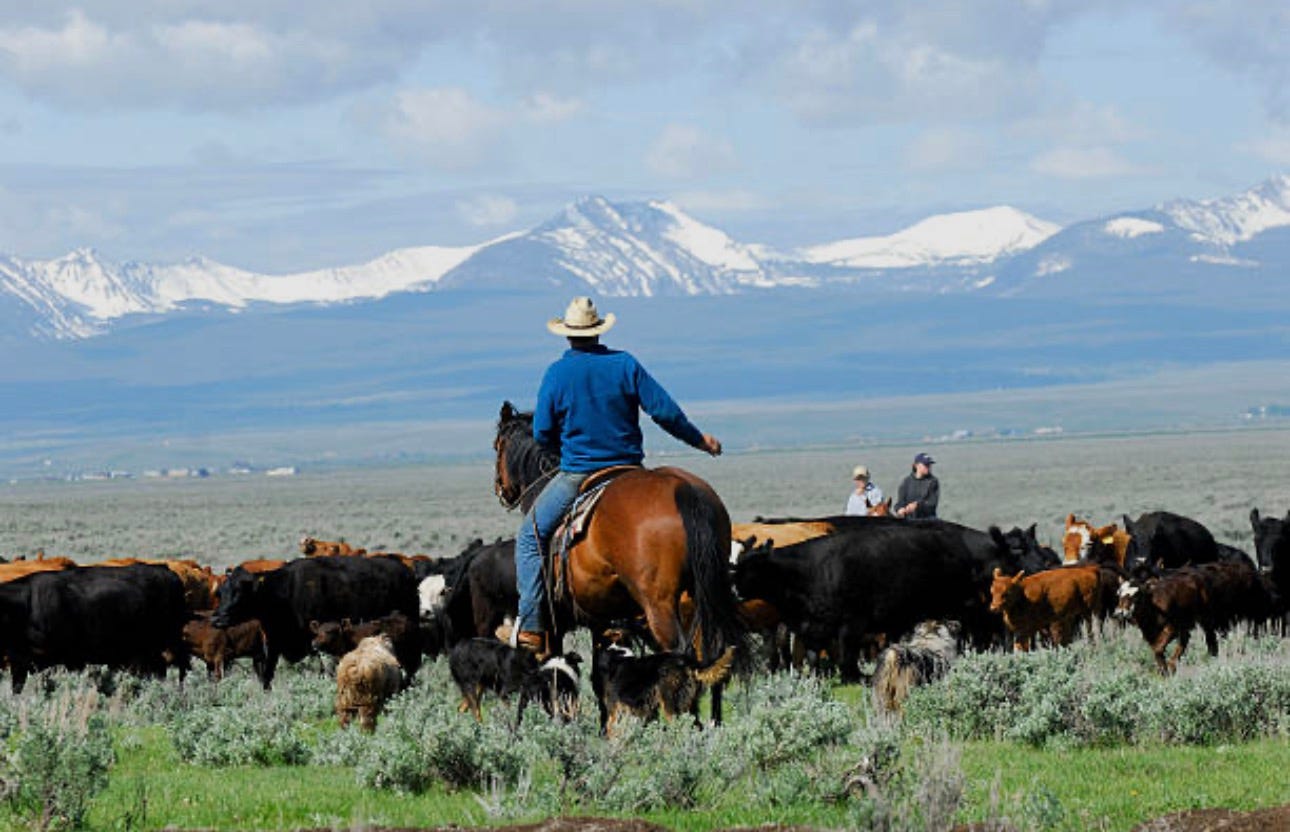
The four largest meatpacking companies handle roughly 85 percent of steer and heifer purchases in the United States. In 1980, the four largest accounted for only 36 percent. USDA says ranchers in many areas now have only two to four serious buyers for their livestock. Researchers have found evidence in recent years consistent with weakened competition and lower cattle prices, although USDA is careful to note that high concentration by itself does not prove anticompetitive behavior.
Try to imagine that market from the rancher’s perspective.
You spend years raising cattle. You carry the risk of weather, feed prices, disease, interest rates, equipment, land costs, and labor. Eventually those animals have to be sold. Cattle are not software licenses. You cannot leave them sitting on a shelf for nine months until someone offers a better price.
If there are only a few serious buyers in your region, your negotiating position becomes pretty obvious.
Then walk into the grocery store.
The consumer is staring at an expensive package of beef wondering why dinner costs so much. The rancher may be wondering why he is not seeing more of that money. Between them sits a highly concentrated processing and distribution system.
We tend to talk about inflation as though it floats down from the sky. Politicians blame the president. Presidents blame the previous president. Companies blame input costs. Consumers blame companies. Everyone argues about the final price while very few people ask how much bargaining power exists at each stage of the system.
That is starting to change.
Recently, the Justice Department and USDA expanded their cooperation on competition in agricultural inputs such as feed, fertilizer, fuel, seed, equipment, and pesticides. The administration has also directed USDA to increase enforcement against unfair or anticompetitive practices in livestock markets and to make it easier for smaller meat processors to reach customers across state lines.
America has turned almost everything into a left-versus-right argument, but competition should be one of those subjects where the lines get blurry.
If you believe in free markets, you should want enough buyers and sellers for a market to actually function. If you care about workers and economic inequality, you should worry when enormous companies accumulate enough leverage to dictate terms to smaller producers. If you care about rural America, you should want farmers to have several places to sell what they grow. If you care about grocery prices, you should want companies competing aggressively for your business.
That seems like common sense.
I also think we have developed a strange habit of treating every large corporation as evidence that capitalism is working properly simply because the company succeeded in a capitalist system.
Sometimes scale represents extraordinary efficiency. Cargill moves enormous amounts of food around the world. Large processing plants can operate more cheaply per animal. Global supply chains can make food abundant and affordable. These are real benefits, and pretending otherwise would make the argument too easy.
Scale can also change the nature of the market.
A company that grows large enough can afford technology its smaller competitors cannot. It can negotiate better transportation rates, gather better market information, survive price swings, buy competitors, influence regulations, and spread compliance costs across billions of dollars of revenue. Every advantage makes the next advantage easier to obtain.
Eventually the small competitor is supposedly competing in the same free market while playing a completely different game.
I see a version of this from the farm.
People love the idea of the independent farmer. Our politics practically worships the image. Every election season brings photographs of candidates beside tractors and speeches about family farms.
The actual farmer may buy seed from an increasingly concentrated seed industry, fertilizer from an increasingly concentrated fertilizer industry, machinery from a handful of manufacturers, and insurance and financing from large institutions. Then the farmer sells into markets where the processors and distributors are increasingly concentrated too.
USDA has found similar concentration far beyond meatpacking. Two seed companies accounted for 72 percent of planted corn acres and 66 percent of soybean acres in the data it studied. Many local grocery markets are also dominated by a relatively small number of chains.
We keep celebrating the independence of the farmer while surrounding that farmer with giants. Then the farmer gets bigger because getting bigger is one of the few ways to survive.
The neighbor retires and sells. Another farm absorbs the acreage. The local processor closes. The regional company sells to a national company. The national company merges with another national company.
Twenty years later everyone looks around and asks what happened to rural America.
Some of the answer is sitting right there in the economics.
There is another reason this worries me. Concentration creates efficiency, but it can also create fragility. When enormous amounts of production pass through a small number of facilities and companies, a fire, cyberattack, disease outbreak, labor disruption, or transportation problem can affect an enormous amount of food very quickly.
We got a glimpse of that during COVID. Supply chains designed for efficiency suddenly encountered conditions they had never been designed to handle. Consumers saw empty shelves while farmers in some cases had products they could not get processed or delivered.
Food feels like an area where a little redundancy might be worth paying for.
A regional slaughterhouse that operates less efficiently than a giant plant may look economically unnecessary right up until the giant plant closes for two weeks. A network of smaller processors may cost more on a spreadsheet while giving ranchers more places to sell and communities more ability to adapt when something goes wrong.
Efficiency is valuable. Resilience is valuable too.
None of this requires believing that Cargill is some cartoon villain secretly controlling dinner. Cargill is a company doing what companies are built to do: grow, compete, increase efficiency, capture market share, and make money for its owners. Its current leadership says the company is investing heavily in technology, artificial intelligence, stronger supply chains, and services intended to help farmers and customers succeed.
The responsibility for maintaining competitive markets ultimately belongs to us and to the government institutions we created for that purpose.
Companies pursue advantage. Government is supposed to make sure advantage does not eventually eliminate meaningful competition.
That means enforcing antitrust law when companies collude or abuse market power. It means scrutinizing mergers in already concentrated industries. It also means making it easier for smaller competitors to exist. There is little value in complaining about giant meat processors while burying the local processor under rules and costs only a giant corporation can comfortably absorb.
Regulation can sometimes strengthen the biggest companies simply because they are the ones wealthy enough to deal with it. A multinational corporation can hire another compliance department. The guy trying to open a small regional processing facility may simply decide the project is impossible.
A serious competition policy has to understand both problems. Keep the giants from rigging the game, and give smaller players a reasonable chance to enter it.
That brings me back to dinner.
Tonight, most of us will sit down and eat without thinking much about any of this, which is probably healthy. Nobody wants to perform an antitrust analysis before cutting into a pork chop.
Still, I think we should occasionally look at the plate and ask how the food got there.
Somebody grew it or raised it. Somebody processed it. Somebody transported it. Somebody sold it. Money changed hands all along the way, and the amount of power held by each participant was very different.
Farmers remain highly visible in the American story of food. The enormous corporations occupying the middle are much less visible.
Maybe that is where we should start looking.
Because when farmers tell us they cannot make enough money and families tell us groceries cost too much, I become very curious about the people standing between them.
Increasingly, there are fewer of those people.
And they are getting very big.
Justin
Opinion Desk
Looking at the Middle, Still
Thank you so much for these insights. So important and in need of reform. And of course, as you note, energy and fuel prices are embedded throughout these "food systems." I am curious, and expect there is analysis of this, ie what % of food cost is energy cost, from the growing to the processing and to the typical long distance transportation of commodity food products along the circuitous route from the farm to the table?
Another piece of this problem... Kids do not even know where their food comes from. If you tell them that the hamburger they just ate came from a cow, they will argue and accuse you of lying. Some don't know what a chicken is. I won't go on.