Below is a photograph from the 1920s. Thousands of members of the Ku Klux Klan are marching through Washington in white robes and pointed hoods. They are not hiding in the woods or meeting secretly somewhere in the South. They are walking openly through the capital as part of a mass political movement that, at its peak, counted millions of members.
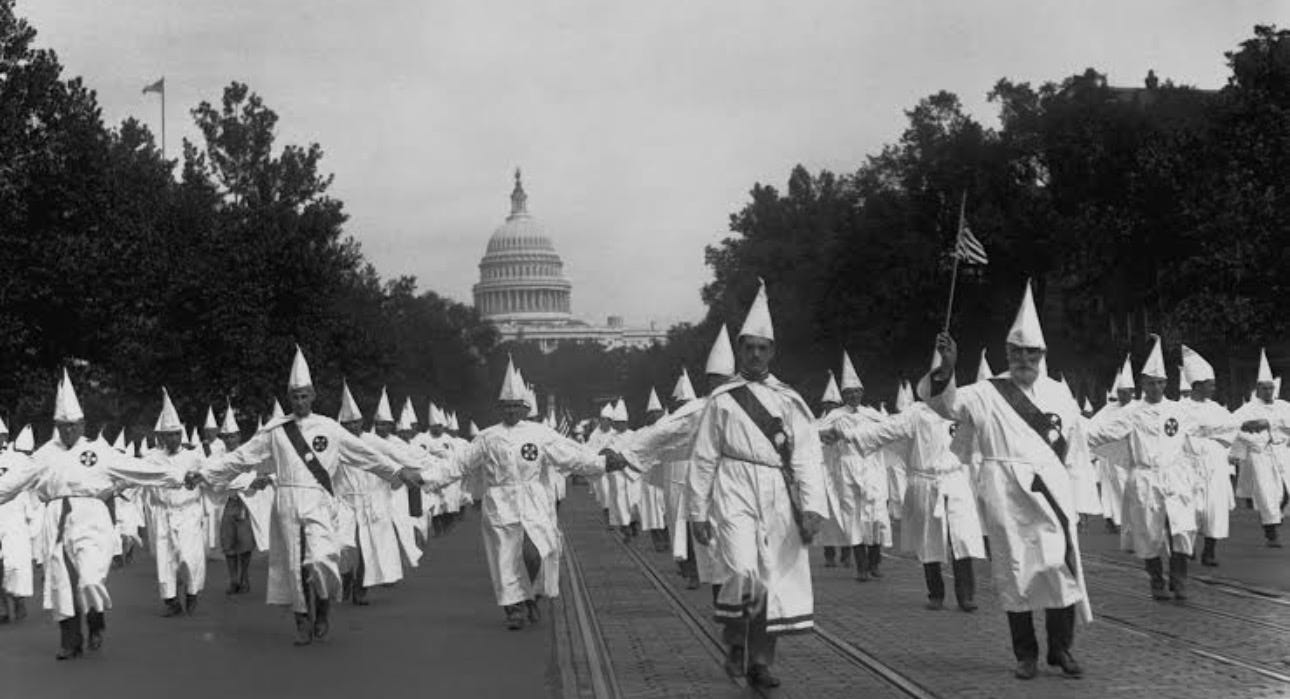
History has a way of turning defeated movements into cartoons. We imagine the Klan as a collection of obvious monsters operating outside respectable society. The reality is much more uncomfortable. The second Klan attracted businessmen, pastors, police officers, local officials, fathers, neighbors, and people who believed they were defending America. Its members talked about patriotism, religion, morality, immigration, law and order, and protecting the country from cultural decline. Beneath all of that sat white supremacy, antisemitism, anti-Catholicism, xenophobia, intimidation, and violence.
A century later, the uniforms have changed. The white hood and the red MAGA hat carry very different histories, and MAGA is a much broader political coalition. Millions of Trump voters support him because of taxes, immigration, judges, regulation, energy policy, or a general distrust of Washington. Calling every Trump supporter a Klansman would be lazy and unfair.
The comparison that interests me is about something deeper. It is about how movements are built.
America Was Better Before
The most important word in “Make America Great Again” may be again.
Again tells a story. America used to be better. Something happened to it. Somebody took that America away. Politics becomes the process of getting it back.
The Klan understood that story very well. The second Klan grew during a period of enormous change. Immigration was transforming cities. Black Americans were moving north during the Great Migration. Women had won the vote. Cities were growing. Religious authority was changing. Old racial and social hierarchies were becoming less secure. For people frightened by those changes, the Klan offered a simple explanation: America had been better before, and dangerous outsiders were ruining it.
MAGA tells a modern version of that story. America has changed rapidly again. Immigration has reshaped communities. Factories have disappeared from towns that depended on them. Churches have emptied. Gender roles have shifted. Gay marriage became widely accepted. The internet shattered old cultural gatekeepers. Fentanyl devastated communities. Economic insecurity remains widespread. Artificial intelligence is beginning to threaten jobs people once assumed were safe.
Those anxieties are real and MAGA gives them enemies.
Immigrants. Globalists. The deep state. Woke universities. The media. Career bureaucrats. Prosecutors. Judges. Democrats. RINOs. Protesters. The list keeps growing.
Trump has repeatedly described domestic opponents as the “enemy within,” and his movement regularly uses the language of invasion, betrayal, corruption, and national decline. Democracy depends on the idea that political opponents still belong to the country. Once opponents become enemies, the rules change. Enemies must be defeated. Restraint starts looking like weakness. Compromise starts looking like surrender.
Fear makes power easier to justify.
Belonging Is Part of the Appeal
There is another parallel that matters just as much. Both movements understood that politics can become an identity.
The Klan had uniforms, rituals, titles, meetings, newspapers, initiation ceremonies, and an elaborate membership structure. It gave people community and belonging. MAGA has hats, flags, rallies, memes, podcasts, influencers, boat parades, merchandise, and an entire media ecosystem.
Politics becomes something you wear.
That changes the relationship between a voter and a political movement. People reconsider policies all the time. Identity is much harder to reconsider. Once your politics becomes your friends, your entertainment, your community, your symbols, and your sense of belonging, criticism of the movement can begin to feel like criticism of you.
Trump has mastered this dynamic. His appeal extends far beyond policy. Loyalty to him has become a test of membership in the movement. Republicans who challenge him become RINOs. Former allies become traitors. Institutions become legitimate when they help him and corrupt when they constrain him. The standard keeps moving while the loyalty stays fixed.
That is where I think the word cult becomes useful, provided we use it carefully. I mean it politically, not clinically. A political cult forms when loyalty to a leader becomes more important than consistency, when inconvenient facts are reinterpreted to preserve the leader’s righteousness, and when disagreement becomes betrayal.
We have watched that pattern repeat for years.
Respectability Is How Extremism Travels
The Klan’s success offers another lesson. Extreme ideas usually gain power after they learn how to sound respectable.
The Klan talked about family values, Christianity, patriotism, morality, law and order, and protecting communities. Those themes created a comfortable wrapper around ugly ideas. People join political movements because someone tells them they are the people finally standing up for what is right, not because they believe in becoming villains.
They are protecting their children. They are defending their country. They are restoring order. They are standing up for people like themselves.
That is how cruelty can enter ordinary political life.
Language gets harsher. Targets become less human. Humiliation becomes entertaining. Ideas that once sounded extreme begin to sound provocative, then debatable, then normal. People adjust along the way.
That is why the current immigration debate deserves more scrutiny than it often receives. A country can control its borders, enforce immigration laws, and deport people who have no lawful right to remain. The more important question is what kind of country we become while doing it.
Do we preserve due process? Do we distinguish dangerous criminals from families and workers? Do we tolerate racial profiling? Do we celebrate suffering because the person experiencing it belongs to a group we have been told to fear?
A government reveals a great deal about itself by how it treats people with the least power.
The Lesson Is the Pattern
The Klan and MAGA are different movements with different histories. The Klan was explicitly committed to white supremacy and used terror, beatings, lynching, arson, and murder to enforce racial hierarchy. MAGA is a mass electoral movement containing millions of people with many different motives.
The warning lies in the pattern.
A country changes quickly. People become frightened and disoriented. A charismatic movement promises restoration and identifies outsiders and internal enemies responsible for the decline. Patriotism becomes fused with loyalty to the movement. Institutions that resist the leader become corrupt. Rules become obstacles. Cruelty becomes easier to excuse because the targets have been portrayed as dangerous. The leader promises that strength will bring back what was lost.
History rarely repeats itself cleanly. The costumes change. The slogans change. The technology changes. Human beings change much less.
We still want belonging. We still fear losing status. We still look for simple explanations when the world becomes confusing. We remain vulnerable to leaders who tell us that somebody else caused our pain and that everything can be restored if we give them enough power.
That is what I think about when I look at the photograph of Klansmen marching through Washington.
The most frightening lesson is how ordinary many of those people probably seemed to themselves. They had families, jobs, churches, neighbors, and reasons they believed were honorable. They convinced themselves that exclusion was patriotism and fear was principle.
A century later, that should make all of us cautious whenever a political movement claims exclusive ownership of America, especially when its promise is to make the country great again.
Justin
Opinion Desk
Taking the Republic Seriously, Still


Brilliant expose’ of history repeating itself. 🙏🖖🏻
I grew up in the south in the 50's. Even being young I saw what was going on. I look back and realize what a terrible time that was. I also saw the changes for the better. I pray I am around to see this latest attack on Amwerica change.