We Built The Domes Because Commodity Farming Was Never Going To Be Enough
This farm still grows blueberries. It also hosts guests, sells experiences, and writes on Substack because modern farming asks small farms to build more than one way to survive.
I want to explain something that can sound romantic from the outside and very plain from the inside. We built the domes because commodity farming was never going to be enough.
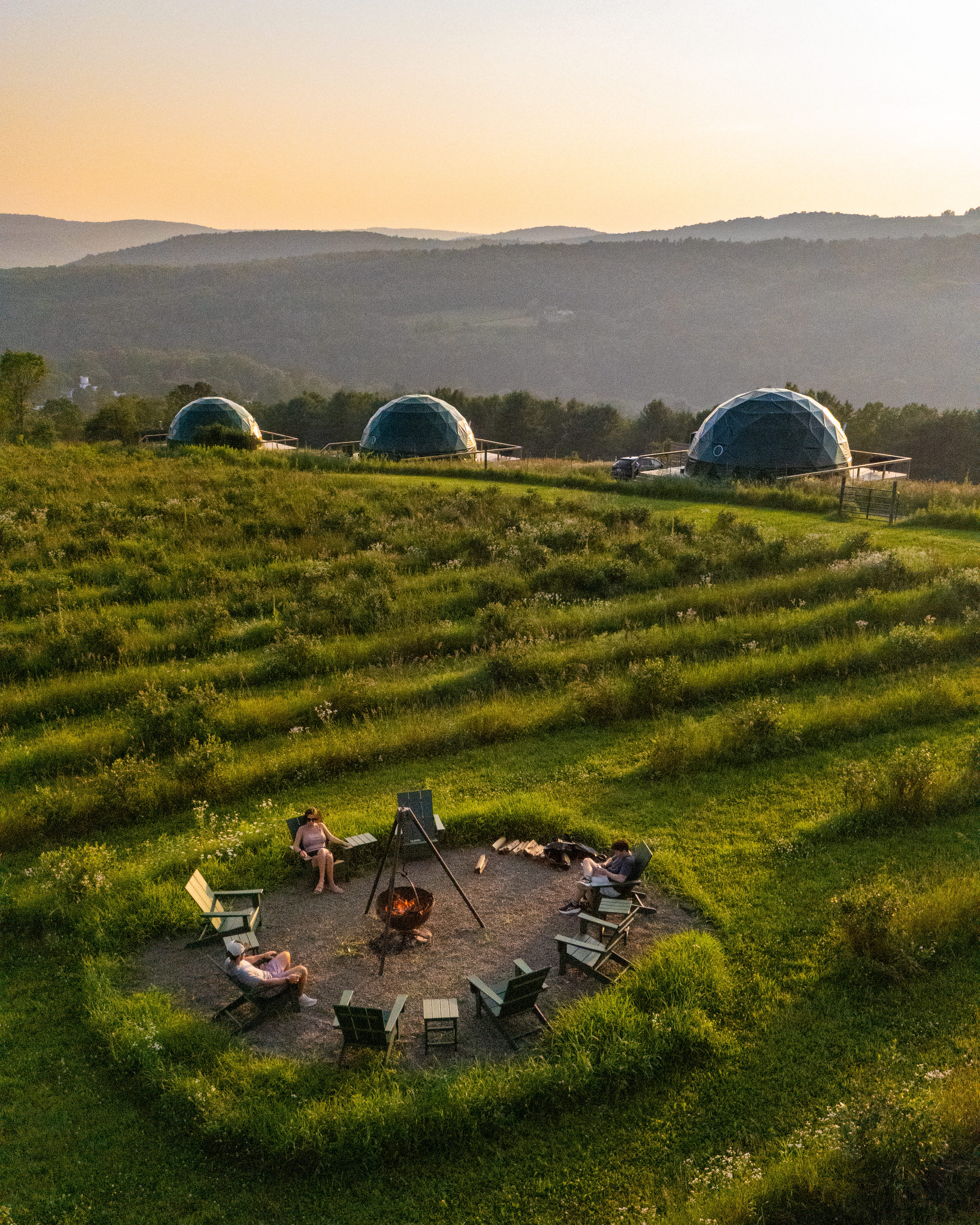
That sentence contains less poetry than people might expect. It contains arithmetic, seasonality, cash flow, debt avoidance, labor reality, and a fairly direct conversation with the modern American farm economy. It also contains a little humility, because I am an experienced businessman and a beginner farmer, which is a funny combination. One part of me still wants to solve problems with systems and spreadsheets. The other part is just entering my third season as a blueberry farmer and learning, with regular correction, that plants, weather, and markets do not care much about your previous résumé.
That has probably been good for me.
It has also made something very clear. A small farm in America often needs more than one engine. It needs a crop, yes. It also needs direct sales, hospitality, events, creativity, and a willingness to build revenue in places the old romantic picture of farming never included. That picture still matters to me. I love the bushes, the rows, and the simple dignity of growing something real in the ground and handing it to a person who will eat it. I love the seasonality of it. I love the fact that blueberries arrive on their own schedule and reward attention rather than speed.
Still, affection does not pay every bill.
That is the part I think people often miss when they picture a farm. They picture the berries, the barn, the field at golden hour, the little bit of dust in the light. They picture a slower, more beautiful life. Sometimes that picture is true. It is also incomplete. A farm is a living system and a business system at the same time. It has fuel costs, equipment costs, labor questions, insurance, taxes, repairs, timing problems, weather risks, and the steady psychological pressure of knowing that your margin can disappear because one thing broke, one rain came at the wrong time, or one market moved in a direction that had nothing to do with the quality of your work.
Blueberries are a wonderful crop. They are also a seasonal crop. The income comes in a window. The expenses behave like they live year-round. The land needs care in all seasons. The plants need attention in all seasons. Infrastructure has no emotional attachment to harvest season. It breaks when it wants.
I came to understand fairly quickly that if North Star Farm was going to have a real future, it would need to speak more than one economic language. It would need to produce fruit and hospitality. It would need to sell blueberries and overnight stays. It would need to be a farm and also a place people could experience. The domes grew out of that realization.
I understand how that sounds to some people. There is a version of the critique that says once you build domes, once you host guests, once you create experiences, you have somehow drifted away from the real thing. I do not see it that way. I think that idea belongs to a version of farming that asks small farms to live inside a purity test while the broader economy moves on without them. I think many of the people who speak most romantically about farming have never had to make payroll, maintain land, repair infrastructure, absorb bad timing, and carry a property through a year in which one revenue stream simply was not enough.
The domes did not replace the farm. They support the farm. They allow the farm to breathe. They allow us to keep doing the agricultural work with more strength and more possibility. They allow the land to carry more value than raw yield alone. Small farms have always created more than food. They create memory, place, stewardship, identity, beauty, and social fabric. The domes simply gave some of that value a clearer economic form.
There is also a deeper truth here. People are hungry for contact with places that still feel alive. They want beauty, quiet, and the chance to walk outside at dusk and hear something besides traffic and panic. They want to pick berries with their children, sit in a hot tub under the trees, and look up and remember that they have a body, that seasons are real, that food comes from somewhere, that a day can still have texture. I do not think that desire is frivolous. I think it is one of the more honest market signals we have.
So the domes are practical and they are also human. They answer an economic need and a cultural one at the same time.
That said, I want to keep my own self-understanding honest. I am still learning how to farm, the pace of blueberry season, what the bushes will teach if I pay attention long enough. I know business better than I know agriculture and that probably shows. It also means I came into this with fewer inherited illusions. I looked at the numbers and the land at the same time. I looked at the rhythms of the crop and the fixed costs of the property. I looked at what the farm could be in a spreadsheet and what it could mean in a person’s life. The domes came from that overlap.
Some people imagine diversification as mission drift. I see it as mission protection.
The farm, the berries, and the land still matter. The sheep, the flowers, the trails, the pond, the events, the Saturday mornings, the conversations by the fire pit, all of that matters too. This place works because it has become more than one thing. It grows fruit, hosts rest, and gives people access to a different pace. It lets the land work with greater range and turns a fragile, single-stream model into something more resilient and more alive.
I think a lot of small farms are facing this same question now, whether they say it out loud or not. What does it take to stay open, keep the land intact, and continue doing honest work in an economy that often rewards scale, sameness, and speed? For us, one answer was the domes.
We built them because the farm needed another pillar, because beauty has value, and because land can nourish people in more than one way.
We built them because a modern small farm often needs multiple forms of revenue to protect the core agricultural one.
We built them because North Star Farm deserved a future sturdy enough to hold the berries, the people, and the place itself.
That is the simple version. The longer version is that I want this farm to keep living. I want the blueberry rows to keep producing and the sheep to keep wandering through the field with the confidence of minor officials. I want families to come here and remember what connection feels like. I want the whole place to keep making its case for a more grounded, more beautiful, more human way of living.
The domes help make that possible.
Justin
Opinion Desk
Third-Season Blueberry Farmer, Longtime Student of Arithmetic


A beautiful expression of what North Star Farm means to you as a Framer/Business man... you forgot articulate/aware satirist! I have high hopes for the farm as your analysis shows a grip on the reality of what you have and each element you need to consider to make the balance work. May your endeavors be blessed with success...love to the sheep
I have been attracted to and following a farm and its people in Saskatchewan that host guests in their grain bins! Likely for similar reasons. The effort and creativity given to maintain a life you need to have is to be admired. And supported. Thank you!