

Aristotle had a more interesting vocabulary for knowledge than we do.
We tend to collapse a lot of different abilities into the phrase “being smart.” Someone knows a lot of facts, we call them smart. Someone can build something complicated, we call them smart. Someone makes consistently good decisions about family, work, money, friendship, or life, and we usually use the same word again.
Aristotle separated these things.
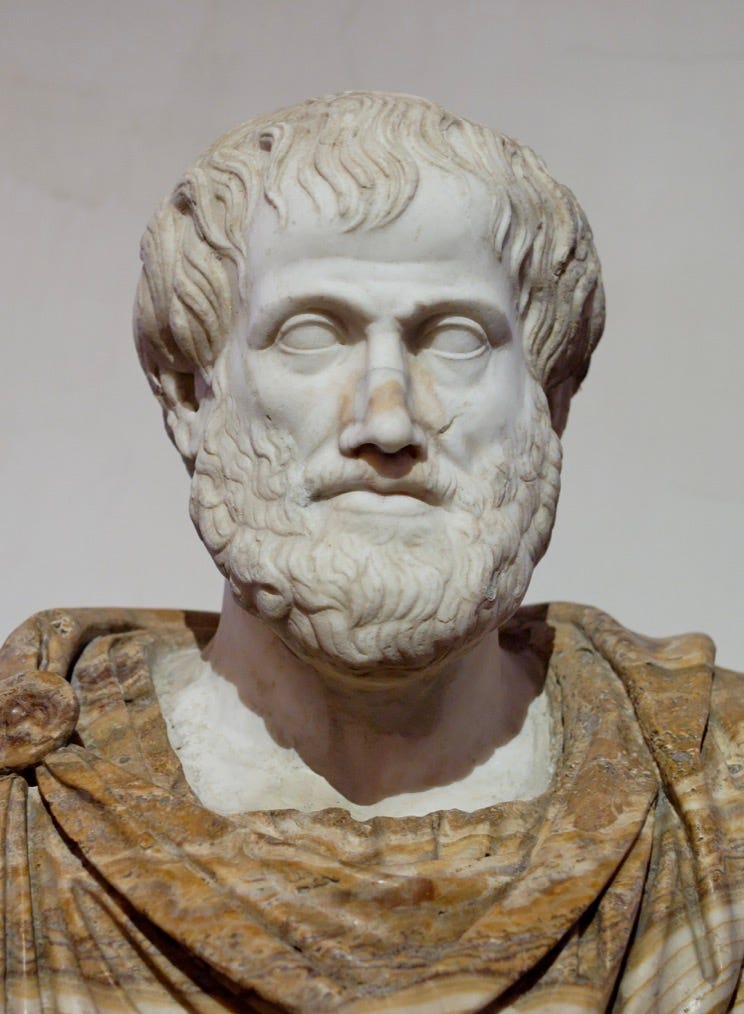
There was episteme, roughly the knowledge of things that can be understood and explained. There was techne, the knowledge involved in making or doing something well, like medicine, carpentry, navigation, or another craft. Then there was phronesis, usually translated as practical wisdom. This was the ability to look at a particular situation, with all of its messiness and uncertainty, and judge what should actually be done.
Aristotle thought experience was essential to that third kind. In the Nicomachean Ethics, he says that young people can become excellent mathematicians, yet practical wisdom is different because it deals with particular situations, and those become familiar through experience. His line is wonderfully simple: experience is “the fruit of years.”
This becomes more relevant as artificial intelligence races forward.
AI has become extraordinarily good at the first kind of knowing. Give a good model a question about chemistry, history, law, computer science, medicine, philosophy, finance, or almost anything else and it can retrieve, synthesize, compare, explain, and reason across an amount of information no individual human being could possibly retain.
It is also becoming frighteningly capable at the second kind. AI writes software, analyzes financial documents, creates images, operates computers, designs things, researches problems, drafts contracts, and increasingly completes multi-step tasks. Stanford’s 2026 AI Index describes capability as accelerating rather than plateauing. On one benchmark that measures agents performing real computer tasks, performance jumped from roughly 12 percent to more than 66 percent in a year. Coding benchmarks that seemed difficult recently are already being saturated.
The speed of this is extraordinary.
I think AI is one of the most impactful technologies humans have ever created. I expect it to make many of us dramatically more productive and to change almost every knowledge-based profession. There are already moments when I ask a machine a question and receive an answer that would have taken me several hours, three phone calls, and a stack of books twenty years ago.
Yet the more capable these systems become, the more interested I am in Aristotle’s third category.
Phronesis. Practical wisdom.
Knowing what matters here, with these people, under these circumstances, in this life. That may turn out to be the most valuable human capacity in the age of artificial intelligence.
Knowing the Answer Is Different From Living With It
Imagine that a 55-year-old person asks an AI system whether he should leave a career he has spent thirty years building.
The machine can do an astonishing amount of useful work. It can calculate their finances. It can model retirement scenarios. It can analyze the labor market. It can compare the expected income from staying with the likely income from leaving. It can ask thoughtful questions about their priorities and produce a remarkably sophisticated decision tree.
Everything it tells them may be intelligent.
The machine has never woken up at 3 am wondering whether it has wasted thirty years.
It has never watched a parent grow old while realizing there are only so many Christmases left. It has never sat across from a spouse and understood, from a slight change in expression, that the conversation is actually about something deeper. It has never chosen money and later wished it had chosen time. It has never chosen time and later worried about money.
The machine can know what regret means. A person knows what regret costs.
That difference is hard to capture on a benchmark.
We have spent much of the AI debate asking whether machines will become more intelligent than human beings. They already outperform most of us in countless narrow intellectual tasks, and the list is growing quickly. I suspect the more important question will become what we do when superior intelligence becomes abundant.
For most of human history, knowledge was scarce. Finding someone who knew the answer was valuable. Knowing how to do something was valuable. Expertise required years of study, apprenticeships, books, professors, travel, mistakes, and experience.
AI is pushing the price of certain kinds of knowledge toward zero and that is good in many ways.
It also changes what becomes scarce.
When everyone can generate an excellent business plan, judgment about which business is worth building becomes more valuable. When everyone can generate a legal argument, judgment about which fights are worth having becomes more valuable. When everyone can produce ten strategies in thirty seconds, deciding which path fits the actual human beings involved becomes more valuable.
Knowledge becomes plentiful. Judgment becomes the bottleneck.
The Danger Is Outsourcing the Wrong Thing
This is where I think we should be careful.
AI makes outsourcing thought incredibly tempting because it is so good at sounding thoughtful.
Ask it what college your child should attend. Ask whether you should fire an employee. Ask whether you should sell the family business. Ask how much time you should spend with your children. Ask what political position is most rational. Ask what kind of person you should become.
You will probably receive a coherent answer. In many cases, you will receive a genuinely useful answer. The danger begins when advice becomes authority.
A machine can help us see possibilities we missed, organize complicated facts, challenge our assumptions, and expose inconsistencies in our thinking. Those are extraordinary gifts. The final act of judgment belongs somewhere else because a human life contains things that are difficult to represent as variables.
There are promises, loyalties, people who depend on us, scars nobody else can see, mistakes we have already made once.
There are things we know about ourselves that would sound irrational if entered into a spreadsheet.
There are moments when the financially optimal choice is the wrong choice.
There are moments when a painful choice is worth making because of the kind of person we hope to become.
Phronesis lives in that territory.
Aristotle understood practical wisdom as knowledge of particulars. The wise person knows the general principle and also sees what this particular situation requires. That knowledge accumulates through living, deciding, failing, watching other people fail, paying consequences, changing your mind, and discovering that principles which sounded simple at twenty become more complicated at fifty.
Life teaches in tuition payments. Some of them are very expensive.
AI Has Never Had to Pay
This is the part I find hardest to get past when people talk about artificial general intelligence as though intelligence naturally becomes wisdom once enough capability is added.
Perhaps machines will eventually simulate wisdom extraordinarily well. They may become better than many humans at predicting which decision will lead to which outcome. They may learn the accumulated patterns of billions of lives and recognize mistakes before we do.
That would make them tremendously useful. Still, AI has never paid for a decision.
It has never lost a friend because it said the wrong thing. It has never spent ten years building something that failed. It has never watched a child become an adult and wished it had been more present. It has never carried guilt. It has never had somebody trust it and then discovered what that responsibility weighs.
When an AI gives bad advice, the consequence occurs in somebody else’s life.
Human wisdom develops partly because consequences change us. Pain edits our theories. Failure humbles certainty. Love rearranges priorities. Age teaches us that several things can be true at once and that many important decisions come without a clean answer.
A machine can read every memoir ever written about losing a parent but the person standing in the hospital room knows something else.
The Age of Wisdom May Be Coming
There is an irony here.
For years we assumed AI would make human intelligence more valuable. I increasingly think it may make certain forms of intelligence less distinctive.
The person who memorizes the most information will face competition from machines that remember vastly more. The person who writes routine code will work alongside systems that produce it almost instantly. The person who can create a competent first draft, summarize a report, analyze a spreadsheet, or research a market will find those skills increasingly available to everyone.
Stanford’s latest AI Index captures how rapidly that frontier is moving while also documenting its jaggedness. Systems that excel at advanced mathematics can still fail surprisingly simple tasks, and agents that appear impressive continue to make significant errors in real-world computer environments.
The human response should involve developing the part of ourselves that benchmarks struggle to measure.
Experience. Character. Taste. Judgment.
The ability to understand another person. The ability to recognize when the technically correct answer is inappropriate for the moment. The ability to sit with uncertainty long enough to discover what the problem actually is. The ability to decide what is worth wanting.
Those things sound softer than intelligence until you have watched a very intelligent person destroy a company, a marriage, a government, or a life.
Then the distinction becomes obvious.
Maybe Aristotle Was Right About Getting Older
Modern culture does not place much value on age. Technology worships the new. Venture capital worships young founders. Social media rewards speed, confidence, novelty, and the ability to have an immediate opinion about something that happened eleven minutes ago.
Aristotle suggested almost the opposite.
Some forms of wisdom take time because you have to accumulate particulars. You need enough life behind you to recognize situations when they return wearing different clothes.
The arrival of powerful AI does not have to diminish humans. It may clarify what humans are for. Machines can help us know more. They can help us make more. They can show us choices, probabilities, patterns, risks, histories, strategies, and possibilities that would otherwise remain invisible.
Then someone still has to decide what matters.
Someone has to choose which future is worth pursuing, which relationship is worth repairing, which risk is worth taking, which principle should bend, which principle should hold, and what kind of life all this intelligence is supposed to serve.
We are entering an age in which knowledge may become nearly unlimited and capability may become astonishingly cheap. Perhaps the scarce thing will be the judgment to know what to do with all of it.
Aristotle had a word for that more than two thousand years ago.
Phronesis.
We usually call it wisdom.
I suspect we are about to discover how valuable it really is.
Justin
Opinion Desk
Still Learning What Matters
This essay is the most thoughtful review of AI and what it means to the human experience that I have read. This is way beyond the sheep's pay grade. Nice job. I view AI in the same vein as I view nuclear power: it has tremendous opportunity to do good and tremendous ability to do evil. With AI we have opened another Pandora's box for which we have little wisdom and even less incentive to use these new powers wisely. This situation does not leave a good feeling in my gut. I envy Aristotle.
bravo! love this!