

Americans love saying that we have free speech.
It is one of those statements that feels so foundational that we rarely stop to ask what it actually means. You can criticize the president. You can insult Congress. You can start a publication, stand on a sidewalk with a sign, argue about religion, mock the government, and tell millions of strangers online that they are wrong.
That freedom is real, and it remains one of the most valuable protections in American life. It is also much narrower than the version of free speech most of us carry around in our heads.
The First Amendment restrains government. It says that government cannot simply silence you because officials dislike your opinion. With limited exceptions, it protects the right to speak without government deciding which political ideas are acceptable.
It does not require Facebook to publish your post. It does not require YouTube to recommend your video. It does not force your employer to keep you after you say something embarrassing. It does not promise that advertisers will stay, friends will approve, customers will continue buying from you, or strangers on the internet will behave reasonably.
That distinction has always existed. What has changed is where Americans actually speak. Increasingly, we do it inside systems owned by someone else.
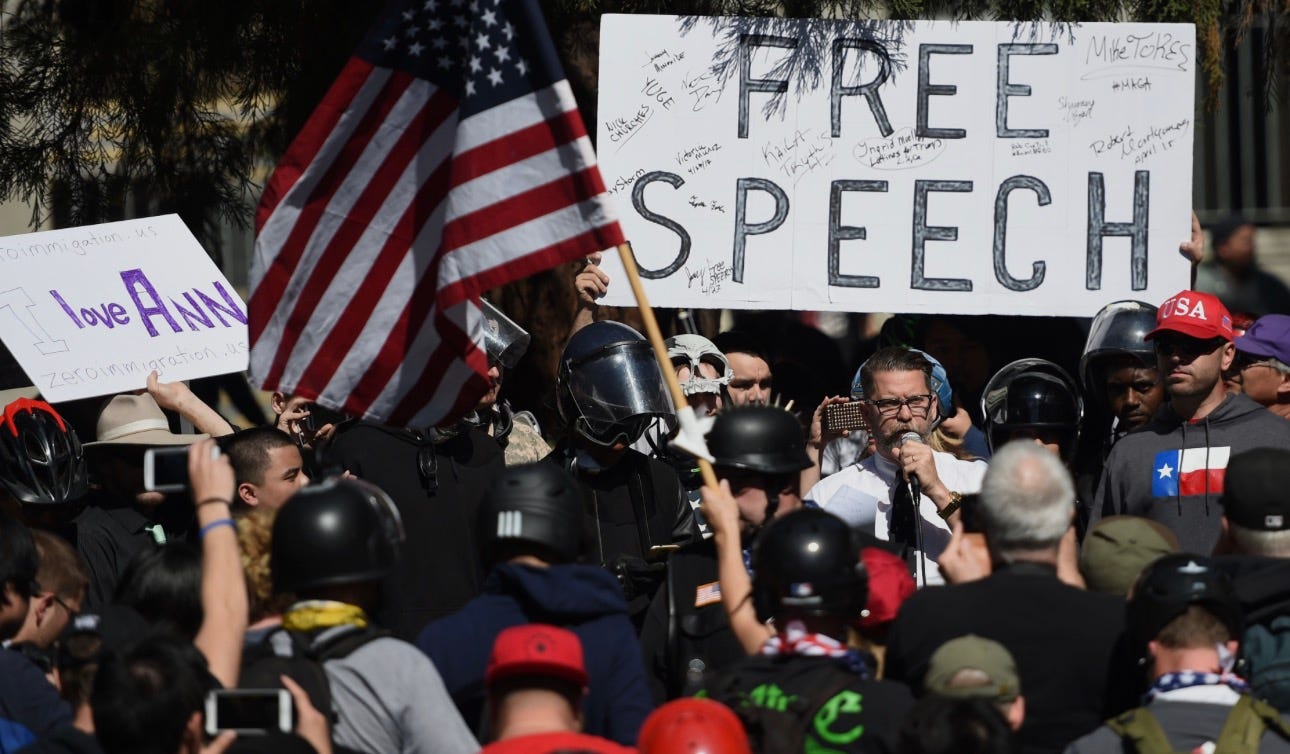
The Town Square Has Owners
For most of American history, public speech happened in physical places. Newspapers, town halls, churches, universities, sidewalks, bars, union halls, radio stations, and eventually television all shaped the public conversation.
The internet was supposed to blow that structure apart.
Anyone could publish. Anyone could build an audience. Gatekeepers would matter less. Information would flow freely.
Some of that happened.
Then a handful of technology companies became the places where billions of people actually encountered ideas.
Today, much of public speech travels through Facebook, Instagram, YouTube, TikTok, X, Reddit, podcasts, search engines, messaging platforms, and increasingly AI systems. These companies make decisions every day about which speech is removed, labeled, promoted, buried, monetized, demonetized, or shown to almost nobody.
The Supreme Court has recognized that this curation is itself a form of editorial judgment protected by the First Amendment. In its 2024 Moody v. NetChoice decision, the Court emphasized that platforms make expressive choices when they determine which posts to remove, prioritize, label, or demote. In other words, Facebook has speech rights too.
That makes the modern free-speech problem much more complicated than government censorship. You can technically speak while almost nobody hears you.
A post can remain online and disappear from distribution. An account can remain active while its reach collapses. A video can exist publicly while an algorithm decides it is unlikely to interest anyone.
That may simply be a private company exercising its own rights. It can also leave users with the strange experience of being completely free to speak inside a room where somebody else controls the lights, the microphone, the guest list, and the door.
The algorithm has become an extraordinarily powerful editor. Most of us have no idea how it works.
Government Is Still Relevant
The complication becomes much more serious when government begins leaning on those private gatekeepers.
The legal line is important. Government officials are allowed to criticize companies, advocate policies, share information, and persuade private actors. The constitutional problem begins when persuasion turns into government coercion.
That boundary has already become a major political fight.
During the Biden administration, officials communicated extensively with social-media companies about COVID misinformation, election claims, and other content. Republican-led states and individual plaintiffs sued, arguing that federal officials had effectively pressured platforms into censorship. The Supreme Court decided Murthy v. Missouri in 2024 on standing grounds, finding that the plaintiffs had not established the required connection between specific government actions and future platform moderation. The Court therefore did not resolve the broad constitutional merits of those allegations.
Now similar questions are being asked about a Republican administration.
This month, a Senate committee advanced legislation that would allow people to sue federal officials accused of coercing private companies to suppress protected speech. Supporters cited examples involving pressure on technology companies during the Biden years and recent pressure on broadcasters during the Trump administration. The ACLU supported the legislation as a protection against government coercion.
The fact that these concerns can migrate so easily between administrations should tell us something.
Free speech principles become much easier to understand when the person doing the speaking annoys us.
The Current Test
We are seeing that principle tested right now.
President Trump recently barred CNN, MS NOW, and Politico from White House grounds after criticizing their coverage as fake news. The organizations have sued, arguing that the government punished them because of their journalism. The White House argues that access is a privilege and that the outlets remain free to report from elsewhere. Courts will decide the constitutional questions.
At roughly the same time, Disney and ABC have been fighting an unusual early FCC review of licenses for ABC-owned stations. Disney argues that the process is retaliation for coverage and programming disliked by Trump. FCC Chairman Brendan Carr has defended the agency’s authority, while one Republican senator, Ted Cruz, has also criticized the prospect of government acting as a “speech police.”
Free speech becomes meaningful when you defend it for someone you dislike.
Most of us are perfectly comfortable protecting speech that sounds reasonable to us. The real test comes when someone says something offensive, foolish, politically inconvenient, factually disputed, or deeply contrary to our own beliefs.
Every political movement eventually develops an explanation for why its preferred censorship is different.
The speech is dangerous. The information is false. The speaker is irresponsible. National security is at stake. Children need protection. Democracy itself is threatened.
Sometimes those concerns are legitimate. Speech can cause harm. Fraud, threats, defamation, harassment, incitement, and certain other categories create real legal and social problems. The danger appears when exceptional reasons become ordinary tools.
Then There Is the Social Censor
Government and technology are only part of this. There is another force shaping speech that no court can easily regulate: us.
Social media transformed disagreement into a permanent public record. A bad joke once disappeared after dinner. Today it can be screenshotted, reposted, stripped of context, delivered to your employer, and viewed by several million people before breakfast.
That changes behavior.
People learn which subjects are dangerous at work. They learn what their friends will tolerate. Professors learn what will trigger students or administrators. Employees learn what might anger executives. Executives learn what might anger customers. Public figures learn which opinion will produce the next online campaign demanding consequences.
Some of those consequences are entirely legitimate exercises of other people’s freedom. Free speech includes the right to criticize someone else’s speech.
A boycott is speech. A protest is speech. Telling a company that you dislike its spokesperson is speech. A newspaper deciding that your opinion is not worth publishing is exercising its own editorial freedom.
The result, though, can be a culture where legal freedom remains broad while practical willingness to speak becomes narrower. That is harder to measure. Nobody has to arrest you.
Sometimes the possibility of becoming unemployable, socially radioactive, permanently searchable, or algorithmically mobbed does plenty of work on its own.
AI Makes This Stranger
Artificial intelligence is about to complicate the situation further.
The cost of producing speech is collapsing. One person can generate thousands of posts, images, videos, voices, comments, political messages, and convincing imitations of other human beings.
That means platforms will increasingly rely on machines to decide what other machines are allowed to say.
Think about how strange that is.
AI generates the content. Algorithms distribute it. Automated systems evaluate it. Other algorithms decide whether it violates rules. AI assistants summarize the resulting argument for people who never read the original.
The public square is increasingly becoming a conversation among humans mediated at almost every step by software.
At the same time, Americans are deeply uneasy about the companies building these systems. A Reuters/Ipsos poll this month found 73 percent of respondents worried that AI companies are doing too little to prevent potentially catastrophic harms, while confidence in industry self-regulation remained low.
We are therefore moving toward a strange arrangement where the institutions deciding what information reaches us are becoming more technologically powerful while the public trusts them less.
That seems like fertile ground for trouble.
Free Speech Is More Than a Legal Right
I do not think free speech in America is fake.
The First Amendment is real. Independent media remain real. People criticize the president every day. Americans openly attack Congress, corporations, religions, universities, political parties, billionaires, police departments, judges, and one another.
That is worth defending.
The illusion is believing that the First Amendment alone guarantees a free culture.
It does not.
A society where government avoids censorship but citizens are afraid to speak can still become intellectually brittle. A society where anyone can post but a handful of opaque algorithms control who gets heard has created a different kind of gatekeeper. A society where political leaders use regulatory power to frighten media organizations risks turning formal freedom into something more conditional. And a society where every disagreement becomes a campaign to punish somebody eventually teaches people to keep their mouths shut.
The healthier goal is more demanding than simply saying, “We have free speech.”
We need institutions willing to tolerate criticism, companies transparent about how they moderate and distribute information, governments that resist using official power against inconvenient speakers, and citizens capable of hearing things they dislike without immediately demanding somebody lose a job.
Most important, we need a cultural understanding that freedom of speech was never designed primarily to protect comfortable ideas.
The difficult speech is the whole point. Comfortable ideas rarely need protection.
The offensive speech. The unpopular speech. The speech that challenges whoever happens to hold power. The speech we think is stupid. The speech that makes us angry enough to wish somebody would shut the person up.
That is where our commitment to free expression becomes real. America still possesses an extraordinary constitutional protection for speech.
The question facing the technological age is whether we will preserve the culture required to make that protection mean something.
Justin
Opinion Desk
Still Saying It Out Loud
A very thought-provoking article. Excellent work.
A scary future for my grandkids!😳